
Saving Links with Ideate BIMLink

Links are automatically saved and read from the Revit project, template, or family file. 


One easy way to re-use links is to save them in a Revit template file. Additionally, by manually saving and loading link definitions to a disk, you can transfer the link definitions from one Revit project to another. 


To save a link to a disk, right click on the link name in the main dialog and select “Save Link Definition.” See image below. The links will be saved in individual files with a .link file extension.


Links based on Revit Key Schedules are unique to a particular Revit project, and you CAN’T save them to an external link definition file. Instead, use the Revit “Insert from File” method to transfer a Key Schedule between projects, and then use By Schedule to create a new link based on this version of the key schedule.
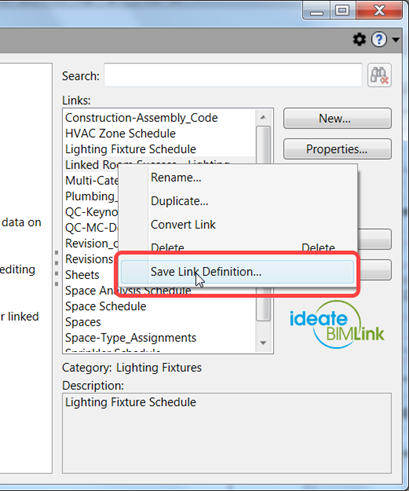
Saving links

Explore recent posts

What's New in Ideate Software, June 2026 Webinar
August 6, 2026
VIDEO - TRAINING | Watch this webinar to see how Ideate ExportHub, the newest addition to the IdeateApps suite, simplifies Revit export workflows. Learn how to centralize exports, automate batch and scheduled exports, apply intelligent naming rules, and create dynamic sheet and view sets for client deliverables.
Master Complex Revit Export Automation With Ideate ExportHub
July 9, 2026
TRAINING - VIDEO | Master even the most complex Revit export workflows with Ideate ExportHub, part of IdeateApps, and Ideate Automation.
Fast Multi-Format Revit Export Packages Using Ideate ExportHub
July 9, 2026
TRAINING - VIDEO | Build powerful multi-format export packages with Ideate ExportHub, part of IdeateApps. Configure each export with custom sheet and view selections, naming rules, destination folders, and more.
Clean, Streamlined Revit Exports Driven by Ideate ExportHub
July 9, 2026
TRAINING-VIDEO | Take control of your Revit exports with Ideate ExportHub, part of IdeateApps. Create fast, single-format exports with precise control over sheet and view selection, naming rules, destination folders, and more.
Show More